
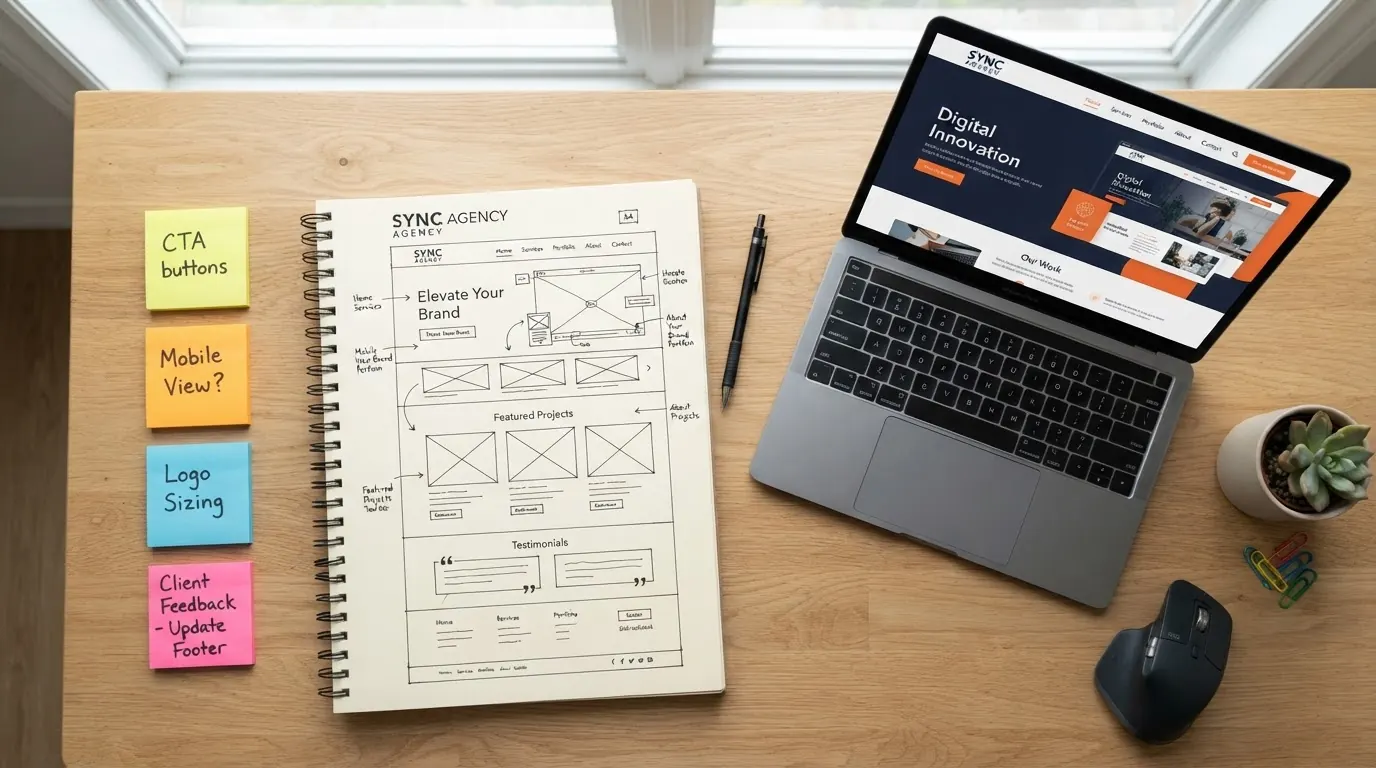
The quick answer: A small business website in 2026 needs to do three things: rank on Google so people can find it, build trust so visitors stay, and convert visitors into leads or customers. Most small business websites fail at all three — not because of bad design, but because they’re missing the fundamental elements that actually drive results. Here’s exactly what your site needs to include.
The Essential Pages Every Small Business Website Needs
1. A Homepage That Answers Three Questions in 10 Seconds
Visitors decide within 10 seconds whether to stay or leave. Your homepage must immediately answer: What do you do? Who do you serve? Why should I trust you? Lead with a clear headline that names your service and your location. Follow with a single, obvious call to action. Remove anything that doesn’t serve those three answers.
2. A Services Page (or Individual Service Pages)
One page per service is better than one page listing all services. Individual service pages rank better on Google, give you space to explain each offering properly, and let you target the specific keywords customers search for. If you offer web design, local SEO, and lead generation — each should have its own page.
3. An About Page That Builds Real Trust
People hire people, not companies. Your About page should tell your story, show your face, explain why you do what you do, and list any relevant credentials, certifications, or community involvement. For local businesses, mentioning your community connection is a trust signal that national companies can’t replicate.
4. A Contact Page With Multiple Options
Phone number, email address, contact form, and your physical location (even if you’re a home-based business — a city name is enough). The easier you make it to reach you, the more people will.
5. A Blog or Resources Section
A blog isn’t optional in 2026 — it’s one of the most powerful local SEO tools available. Each blog post is a new page that can rank for a different keyword, answer a question your customers are asking, and bring in organic traffic that costs you nothing. Aim for one well-written post per month minimum.
A 5-page website can work — but a 10–15 page website with dedicated service and location pages will almost always outrank and outperform it.
The Features Every Small Business Website Needs in 2026
Mobile-First Design
Over 60% of web searches happen on phones. If your website is hard to use on a phone — slow to load, hard to tap, text too small — you’re losing the majority of your potential customers before they read a single word. Mobile-first isn’t a nice-to-have. It’s the baseline.
Fast Loading Speed
Google uses page speed as a ranking factor. Visitors abandon pages that take more than 3 seconds to load. Compress your images, minimize unnecessary code, and use a fast host. If your site takes more than 3 seconds to load on a phone, you have a problem.
A Clear Call to Action on Every Page
Every page should have one primary action you want visitors to take — call now, book a call, get a quote, send a message. Make it visible. Make it easy. Repeat it. Don’t make visitors hunt for how to contact you.
An SSL Certificate (HTTPS)
If your website still shows “Not Secure” in the browser bar, that’s a trust killer. SSL certificates are free with most modern hosting. There is no excuse for running an insecure website in 2026.
Local SEO Foundations
Your city and region should appear in your page titles, meta descriptions, headings, and body copy. Your Google Business Profile should be linked and consistent with your website. Your NAP (Name, Address, Phone) should be identical everywhere online.
A Contact Form Connected to Your CRM
When someone fills out a form on your website, that lead should instantly appear in your CRM so you can follow up fast. The businesses that follow up within 5 minutes win far more clients than those that check their email the next day.
What Most Small Business Websites Are Missing
These are the gaps that separate websites that generate leads from websites that just sit there.
Real photos — Stock photos are trust killers. A photo of the actual owner, actual team, or actual work builds far more credibility than a smiling stock model.
Social proof — Testimonials, Google review count, client logos. People trust what other people say about you more than anything you say about yourself.
Specific local signals — “Serving Peace Country and northern Alberta” beats “serving Alberta businesses” for local customers. Be specific about who you serve and where.
A clear value proposition — Why you, not your competitor? If your website doesn’t answer this directly, you’re leaving it to chance.
Schema markup — JSON-LD structured data helps Google understand your business type, location, services, and reviews — and improves how you appear in search results.
The 2026 Small Business Website Checklist
- Homepage with clear headline and CTA
- Individual service pages
- About page with photo
- Contact page with form
- Blog section
- Mobile-optimized design
- Sub-3-second load time
- SSL certificate (HTTPS)
- Local SEO in titles and headings
- Google Business Profile linked
- NAP consistent everywhere
- CRM-connected contact form
- Testimonials or Google reviews displayed
- Real photos (not stock)
- Schema markup (JSON-LD)
- Clear CTA on every page
Does Your Website Have All of This?
If you’re not sure — or if you know the answer is no — book a free website review. We’ll go through your current site, identify every gap, and tell you exactly what it would take to turn it into a site that ranks and converts.